austin
2026-05-07
Balancing Tech Growth with Income: The Income Anchor Strategy
For the income-focused investor, the promise of the AI revolution presents a classic dilemma: how to capture the explosive growth of tech giants like NVIDIA and AMD without subjecting your portfolio to the volatility that often accompanies them.
Relying solely on capital appreciation is risky for those who rely on their portfolios for cash flow. Conversely, ignoring high-growth sectors can leave a portfolio stagnant. The solution is not choosing between growth and income, but effectively blending them.
The Core-Satellite Approach
You may consider an "Income Anchor" strategy designed to stabilize portfolio volatility while remaining exposed to the secular AI growth trend.
The Allocation Framework
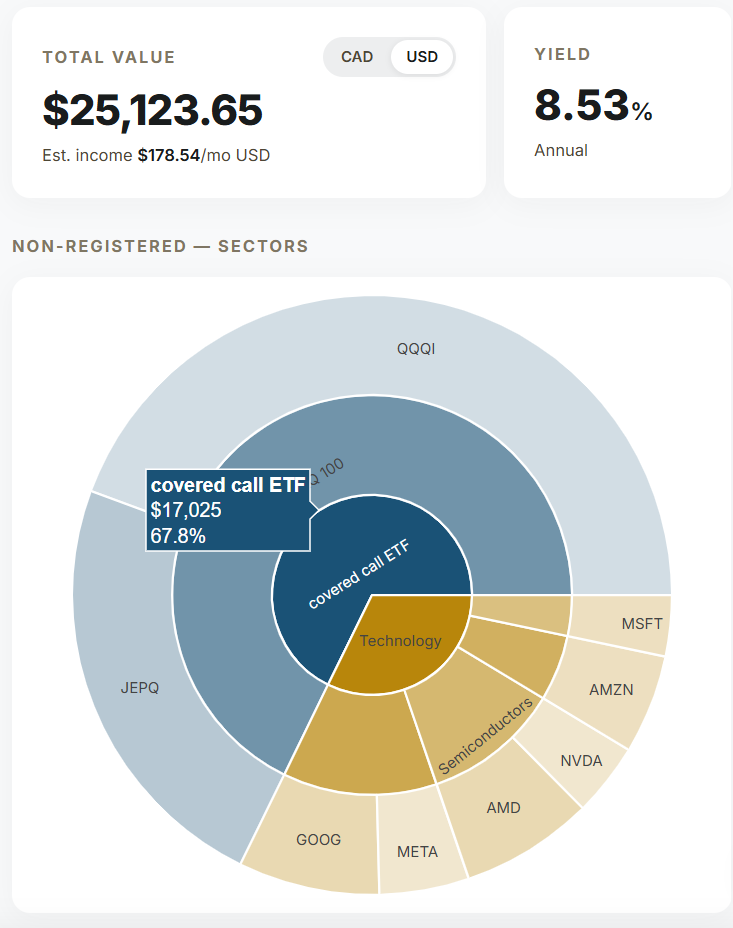
- The Core (~70%): High-yield income instruments like QQQI and JEPQ. These ETFs provide consistent monthly distributions by harvesting option premiums from NASDAQ-100 volatility.
- The Satellite (~30%): High-conviction growth leaders (e.g., NVDA, AMD). This slice provides the potential for capital appreciation, acting as the portfolio's growth engine. If you believe that big tech companies can be another way to enjoy the growth, you may consider adding the big tech companies like GOOG, AMZN, MSFT, or META into the mix.
Why This Works
The primary challenge with pure-growth portfolios is drawdown risk. When the tech sector corrects, growth-only portfolios often suffer significant paper losses that can be difficult to stomach when monthly income is a priority.
By shifting a majority of the allocation into covered-call ETFs, you are essentially "buying insurance." These instruments convert the inherent volatility of the tech sector into tangible monthly cash flow. If the market trades sideways or slightly upward, you participate in the income stream generated by the fund's options strategy. If the market rallies sharply, your satellite holdings (NVDA/AMD) ensure you capture the "alpha" of the sector's expansion.
Analytical Resilience
Recent performance metrics reinforce the effectiveness of this approach. As of May 2026, income-focused tech ETFs such as QQQI and JEPQ have demonstrated resilience, with year-to-date (YTD) NAV value gain of ~3-6% while collecting monthly income over 12% per annum, with the effective total return over 10% YTD.
These funds have proven that they can offer competitive total returns by pairing NASDAQ-100 exposure with systematic yield generation. They do not eliminate volatility, but they do change its nature: instead of price fluctuations being purely additive to risk, they are harvested as income.
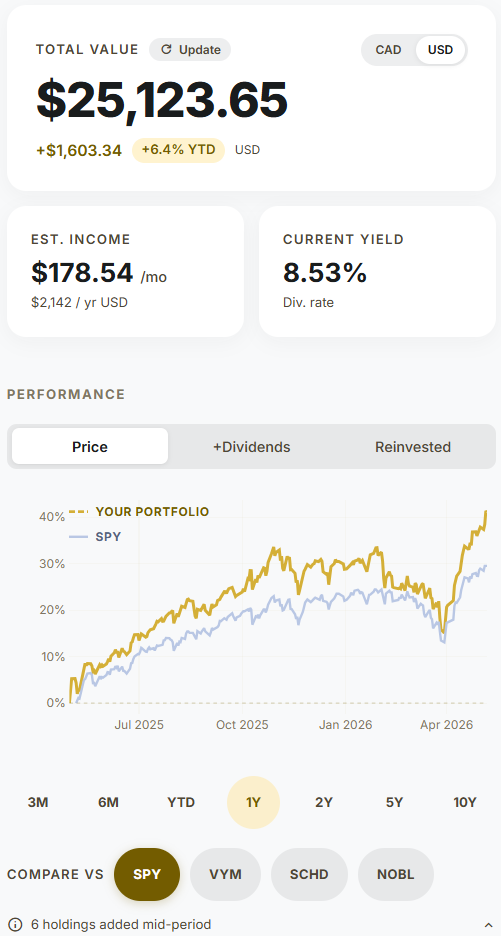
Hypothetically, if you held this 70:30 covered call ETF plus the stock portfolio mix, the increase in the overall NAV value (or the principal amount of your investment fund) would have been comparable to that of SPY (S&P500) ETF, while collecting over 8% annum dividend, which would be deposited on your account on monthly basis.
Conclusion
The AI demand cycle is unlikely to fade in the near term, but the path forward will continue to be turbulent. For investors who need to balance their long-term growth objectives with their immediate need for income, the Income Anchor strategy provides a clear path forward.
By grounding your portfolio in high-yield ETFs, you ensure a consistent cash flow that allows you to remain disciplined and stay invested, even when the market tests your conviction.
Disclaimer: This content is for informational purposes only and does not constitute financial advice.