austin
2026-08-11
Canada's Office REITs Haven't Recovered. That Story Is Still Live
Canada has not followed the same script. As of today, Canadian office REITs remain meaningfully below the broader Canadian REIT index for the year, while industrial and grocery anchored names have outperformed. This is not a stale narrative here. It is still playing out.
What Happened to Allied Properties
Allied Properties REIT, the largest pure play office REIT in Canada, gives the clearest picture of what has actually gone wrong. The stock dropped sharply in late 2025 when the company announced a distribution cut. Then in early 2026 it dropped again, this time on a dilutive $500 million equity offering priced at $10 per share, followed by weaker than expected debt metrics and financial results.
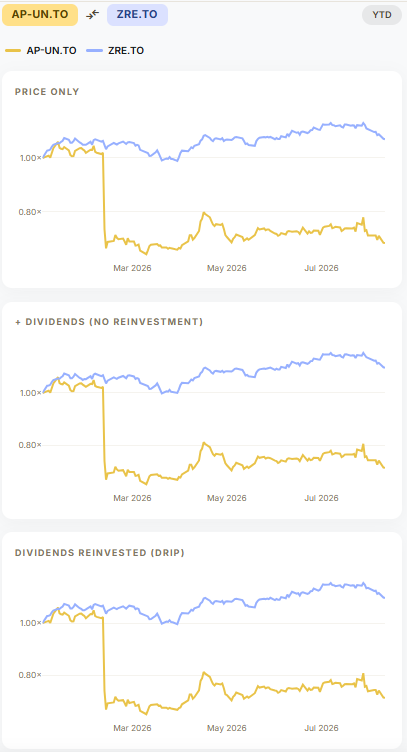
Two separate negative catalysts within a few months of each other explain why AP has not recovered the way BXP and SLG did. The distribution cut removed the income support for the stock. The dilutive offering then increased the share count while the balance sheet concerns were still fresh, compounding the pressure rather than resolving it. AP currently yields around 7.6%, well above the broader index, which reflects the market still pricing in meaningful risk rather than treating the story as resolved.
Dream Office and True North Tell Related but Distinct Stories
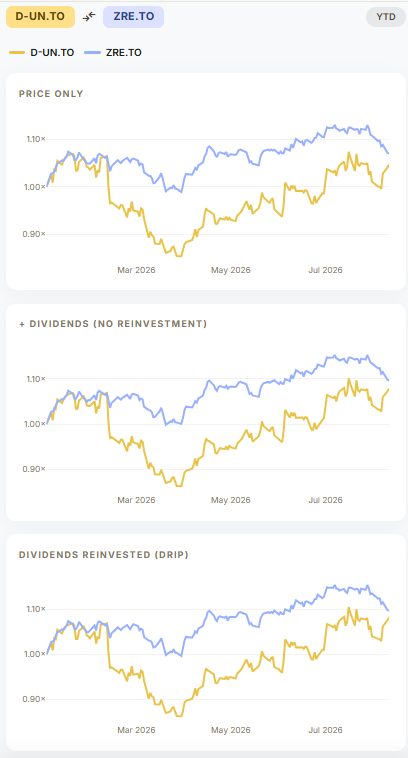
Dream Office REIT dropped alongside AP in the same window, though less severely, and has partially recovered toward the index before pulling back again in recent days. D currently yields around 5.3%. Both AP's and D's dividend charts show a large special distribution in 2023, which reflects a specific asset disposition that year rather than an ongoing pattern, and should not be read as part of the current story.
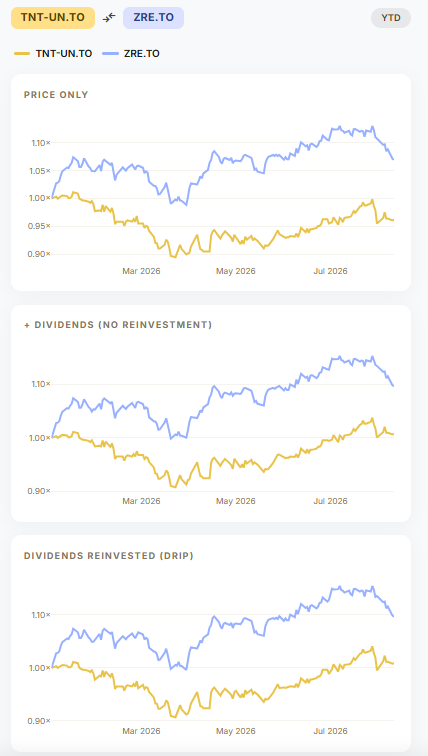
True North Commercial REIT is a smaller, more concentrated name that suspended its distribution for roughly two years before resuming payouts in 2025. Despite that resumption, TNT has lagged the broader index for the entire year without closing the gap, and currently yields around 8%, the highest of the group. The market has not re-rated the stock back toward the index even with the distribution restored, which suggests lingering concern about the underlying portfolio rather than just the payout itself.
Industrial and Grocery Have Done the Opposite
Granite REIT and Slate Grocery REIT both tell a very different story over the same period. GRT tracked closely with ZRE through the first quarter, then pulled meaningfully ahead starting in April, building a lead that peaked around 20% above the index in July before pulling back with the broader market in recent days. SGR followed a similar pattern, tracking the index early in the year before separating from it from April onward and also peaking in July.
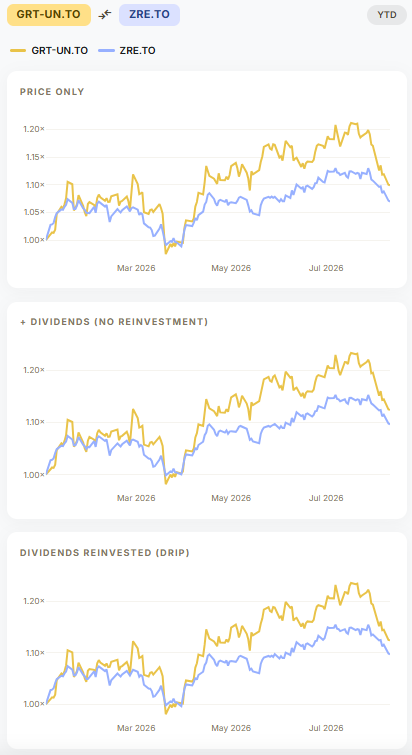
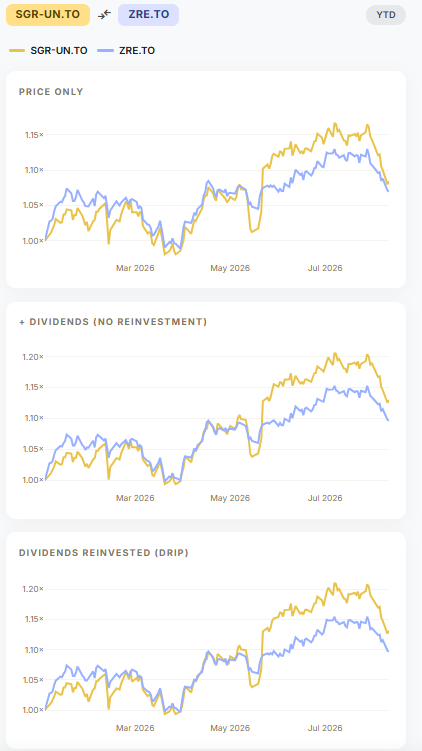
The yield picture adds an interesting wrinkle here rather than a clean confirmation. GRT currently yields around 3.9%, below the broader index yield of 4.4%, consistent with a name trading at a premium on strong price performance. SGR, despite also outperforming on price, still yields around 7.4%, notably higher than GRT and well above the index. That is worth noting honestly rather than smoothing over: strong relative price performance and an elevated yield are not mutually exclusive, and SGR's specific distribution coverage is worth checking directly rather than assuming the price action alone tells the full story.
The Contrast With the US Is the Real Lesson
The comparison to the US matters less as a footnote and more as the actual point. In the US, the office REIT selloff largely resolved within the same year it began, with the most prominent distressed names recovering and in SLG's case outperforming the index by mid year. In Canada, the equivalent story is still unresolved as of today. AP has not meaningfully recovered relative to ZRE since its early 2026 drop. D has only partially recovered. TNT has not recovered at all despite restoring its distribution.
The takeaway is not that Canadian office REITs are permanently impaired while US office REITs are fine. It is that assuming one market's recovery timeline applies to the other is a mistake. An investor reading US headlines about an office REIT rebound and assuming the same applies to their AP-UN position would currently be wrong.
What to Actually Check
If you hold Canadian REIT exposure, the same sub sector distinction that applies in the US applies here, with a Canada specific timeline. Office names like AP, D, and TNT are still working through distribution cuts, dilutive financing, and balance sheet concerns that have not fully resolved in the price. Industrial and grocery anchored names like GRT and SGR have meaningfully outperformed the broader index over the same period.
Before assuming your REIT exposure is impaired because of office headlines, or assuming it is fine because you read a US recovery story, check what you actually hold and where that specific name sits in this timeline today.
This post is for informational and educational purposes only and does not constitute financial advice. Price and distribution data as of August 11, 2026. Always verify current figures against fund provider and company investor relations pages before making investment decisions.