austin
2026-11-11
SCHD or VTI for a Child's Account? The Bigger Dividend Isn't the Bigger Pot
- SCHD pays 2.9% against VTI's 1.1%, yet since October 2011 each unit invested became 7.702 in VTI and 6.923 in SCHD.
- Over the last five years the two finished close: 65.1% for VTI, 62.9% for SCHD, both with distributions reinvested.
- SCHD's edge is a shallower five-year drawdown, -16.8% against -25.4%, but over the longest history the worst drawdowns were almost the same size.
- For money a child won't touch for a decade or more, the data favours VTI as the core holding. Fees and Canadian tax rules are not sourced here and need checking.
A dividend cheque feels like progress. You open a child's account, buy a fund, and watch the payouts arrive every quarter. But if nobody is going to spend that money for a decade or more, the size of the cheque tells you very little about the size of the pot.
For a long-horizon child's account, I'd pick VTI, the Vanguard total US stock market ETF, over SCHD, the Schwab U.S. Dividend Equity ETF. SCHD pays more. VTI has grown more. When the money is reinvested anyway, the second fact is the one that counts.
The payout gap is real, and it mostly doesn't matter
Both funds trade on NYSEArca in US dollars and pay quarterly. Over the trailing 12 months, SCHD paid 1.055 USD per share on a price of 35.83 USD, a 2.9% yield. VTI paid 3.949 USD per share on a price of 369.55 USD, a 1.1% yield. Those are trailing 12-month figures from four quarterly payments, not a promise about next year.
If you want the cheque, SCHD gives you the higher yield. If you want a larger balance in the child's account at the end, you need to look at total return instead.
Five years: a near tie, with VTI slightly ahead
From November 11, 2021 to November 10, 2026, VTI returned 65.1% with distributions reinvested, a 10.6% compound annual rate. SCHD returned 62.9%, or 10.3% a year. That is a gap of about 2 percentage points. I would not call it a decisive win for either fund.
You can check the 5-year window yourself: Compare SCHD vs VTI on Stock Assembler.
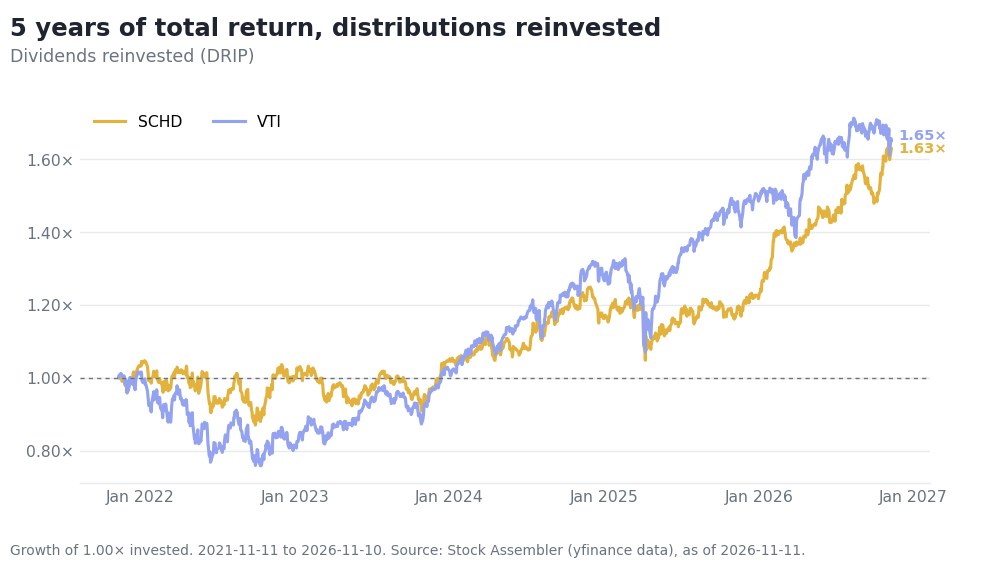
Total return with distributions reinvested, November 11, 2021 to November 10, 2026. Data: Stock Assembler (yfinance).
The return mode matters more than the gap. With distributions not reinvested, SCHD returned 54.3% and VTI 61.5%. On price alone, SCHD returned 36.2% and VTI 54.0%. SCHD hands over more of its return as cash, which is why its price line lags. Reinvest that cash and most of the difference closes.
Fifteen years: the gap widens
The longest common history starts October 20, 2011, when SCHD began trading, and runs to November 10, 2026. VTI traded well before that, so this window is set by SCHD, not by VTI. Over it, VTI returned 670.2% with distributions reinvested, a 14.5% compound annual rate. SCHD returned 592.3%, or 13.7% a year. VTI finished about 78 percentage points ahead.
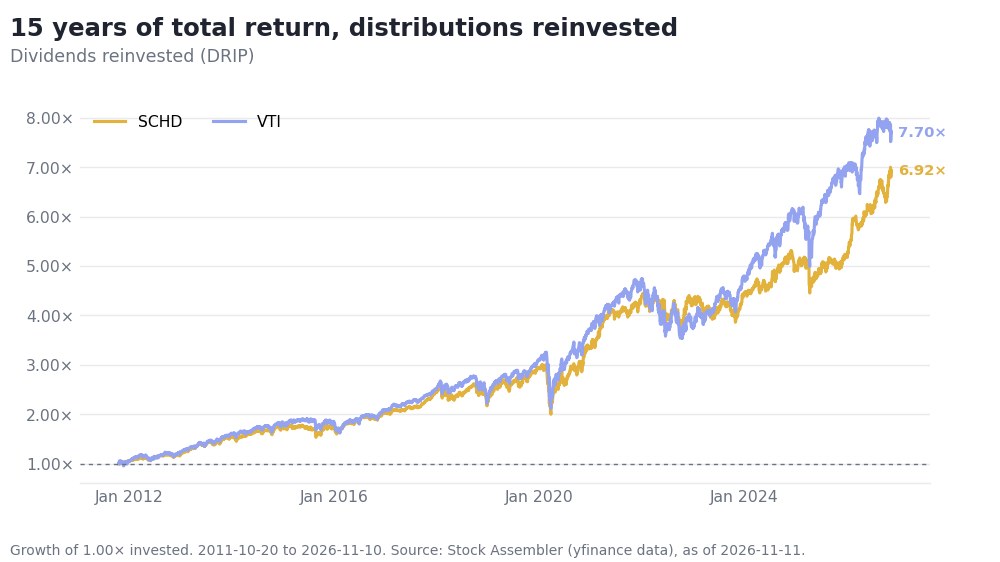
Total return with distributions reinvested, October 20, 2011 to November 10, 2026. Data: Stock Assembler (yfinance).
One way to see it is the end multiple: each unit invested became 7.702 units in VTI and 6.923 in SCHD. A child's horizon is exactly the kind of period where a small annual edge compounds into a visible difference.
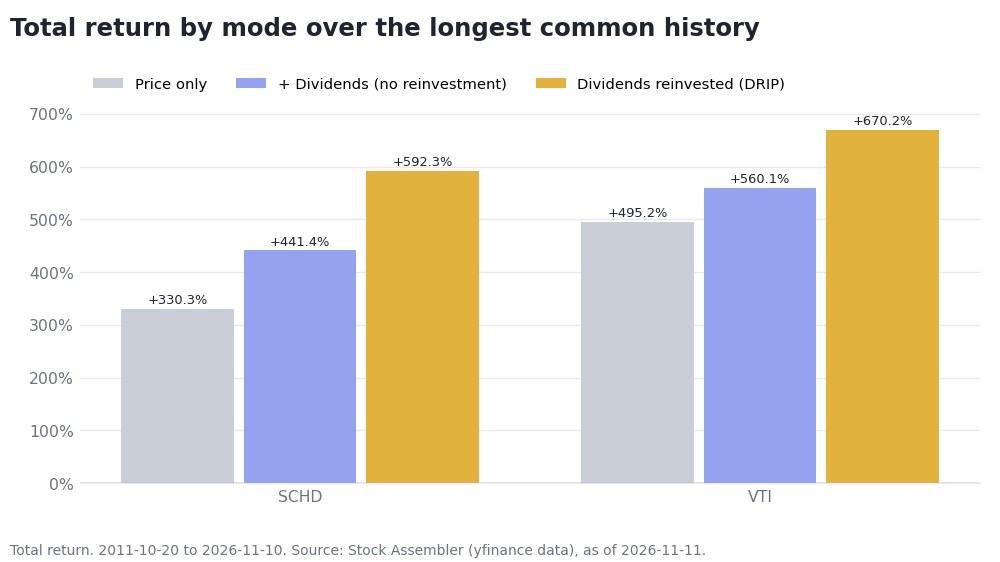
Total return by mode (price only, distributions not reinvested, distributions reinvested), October 20, 2011 to November 10, 2026. Data: Stock Assembler (yfinance).
The bars make the payout-versus-pot point plainly. In both funds, reinvesting adds a lot. In VTI, it also starts from a higher price return, 495.2% against 330.3% for SCHD.
Where SCHD earns its place: the down market
Here is the fair counter-argument. Over the last five years, SCHD's maximum drawdown with distributions reinvested was -16.8%, against -25.4% for VTI. Its annualized volatility was 14.5% against 17.7%. If a smoother ride would stop a family from panic-selling, that has real value.
But I'd push back on treating it as a consistent cushion. Over the longest history, the worst reinvested drawdowns were -33.4% for SCHD and -35.0% for VTI. The two worst drawdowns were almost the same size. I can't say from this data which years those drawdowns happened in, so I won't guess.
My pick, and what to check before you buy
On the data, VTI is the better core holding for a child's account with a long horizon. It led on reinvested total return in both windows, and the lead grew with time. SCHD fits a family that values a smoother ride and accepts a smaller pot.
Before you buy either one, check three things: both funds' expense ratios, whether US withholding applies in the account you plan to use, and whether you will really reinvest the distributions. If you won't, the gap in the not-reinvested numbers above is the one that applies to you.
This post is for informational purposes only and does not constitute financial, tax or legal advice. Return figures from Stock Assembler's Compare Tickers tool (yfinance data), November 11, 2021 to November 10, 2026, and October 20, 2011 to November 10, 2026. Fees, withholding, RESP and in-trust rules were not sourced for this post. Past performance does not guarantee future results.