austin
2026-10-27
OVL vs SPY: The Bigger Cheque Is Real, but the Lead Comes From Reinvesting It
- OVL's trailing yield is 8.4% against 1.0% for SPY, yet price only, SPY gained 161.0% since October 2019 and OVL gained 128.6%.
- With distributions reinvested OVL leads, 204.1% to 188.6%, but over the last five years the two are almost level: 81.6% against 80.3%.
- The issuer attributes 100% of OVL's latest distributions to return of capital, so part of the cheque may be your own money coming back.
- The real decision is whether you will spend the payout or reinvest it.
OVL's trailing yield is 8.4%. SPY's is 1.0%. Yet price only, SPY gained 161.0% since October 2019 and OVL gained 128.6%. With a large lump sum to place, that tension is the whole decision.
My view: OVL's lead over SPY is real, but it belongs to the investor who reinvests the payout. The investor who spends it ends up with a smaller price gain than SPY, but that is offset by the cash received: the no-reinvest totals are essentially identical. The real cost falls on someone who needs neither the cash nor the tax treatment of a payout.
The cheque is bigger, but read the yield carefully
OVL (Overlay Shares Large Cap Equity ETF) paid $4.725 per share over the last 12 months on a $56.50 price, a trailing yield of 8.4%. SPY paid $7.583 per share on a $765.37 price, a yield of 1.0%. OVL pays monthly, SPY pays quarterly.
Two caveats on those figures. OVL's trailing number rests on 10 payments, not 12, and the data shows a gap in its distribution history after December 2024, so I would not lean on any annual distribution total. And you will see higher numbers quoted. The issuer's distribution rate is 10.53% as of September 30, 2026, but that is the latest monthly payment annualized against NAV, not what a holder actually received over a year. I use the trailing figure here because it is the one that has already been paid.
Reinvest everything and OVL edges ahead
From OVL's launch on October 1, 2019 to October 26, 2026, both funds trade in US dollars, so the comparison is clean. With distributions reinvested, OVL returned 204.1% (17.0% a year, an end multiple of 3.04x). SPY returned 188.6% (16.2% a year, 2.89x).
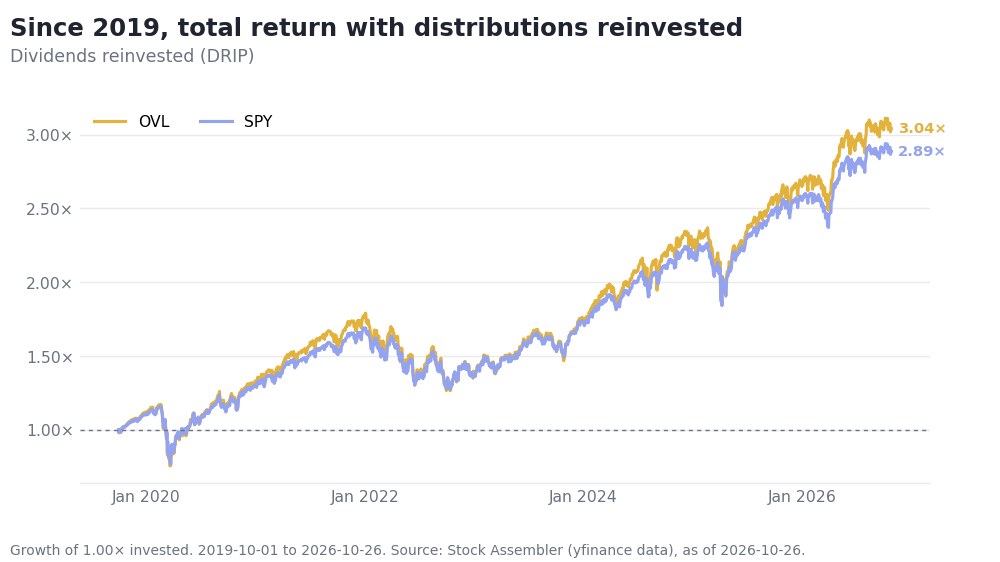
Growth of 1.00x invested with distributions reinvested, October 1, 2019 to October 26, 2026. Data: Stock Assembler (yfinance).
That is a win for OVL, but a narrow one, and it depends on where you start the clock. Over the last five years, from October 27, 2021, OVL returned 81.6% with distributions reinvested and SPY returned 80.3%. For practical purposes, a tie.
It also was not a smoother ride. OVL's annualized volatility was 22.2% against 19.7% for SPY, and its maximum drawdown was -35.5% against -33.7%. The deepest losses most likely date to the early-2020 sell-off, though I have not verified the dates. An income fund that wobbles more than the index is not what most people expect when they buy for the cheque.
Spend the payout and the price tells the story
Now switch off reinvestment. Without reinvesting distributions, OVL returned 177.8% and SPY 176.6%, essentially identical. Price only, SPY returned 161.0% and OVL returned 128.6%, so SPY is well ahead on price alone.
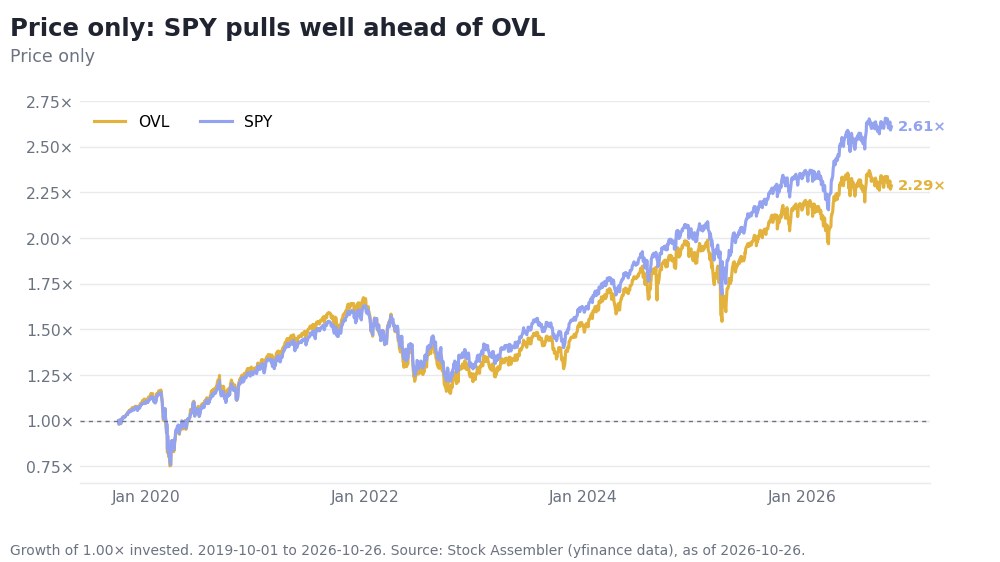
Growth of 1.00x invested, price only, October 1, 2019 to October 26, 2026. Data: Stock Assembler (yfinance).
The price-only line is what you are left holding if you spend every distribution. The five-year picture is the same: price only, SPY gained 68.6% and OVL gained 44.4%. OVL's smaller price gain is the other side of the bigger cheque. Add the cash back and, as above, the totals are essentially identical.
Some of that cheque may be your own capital
This is where I would push hardest. The issuer's footnote says 100% of OVL's distributions were attributable to return of capital as of September 30, 2026. That is not a final tax characterization, and I have not seen the full-year notices, so I would not call it a settled annual figure.
Return of capital is part of what you put in being handed back to you. If a large share of the payout is capital coming back, that matters for how you treat the cheque, so check the full-year notice before counting it as income.
Fees and what I could not check
OVL charges an expense ratio of 0.79%. SPY's gross expense ratio is 0.0945%. The fee gap is already reflected in the returns above.
This post does not cover how either fund behaved in 2022 or how a TFSA or RRSP treats US-listed distributions, including return of capital. For a Canadian holder of USD funds, the tax question is worth a conversation with a professional.
What I would check before choosing
Decide first whether you will spend the payout or reinvest it. If you will reinvest, OVL and SPY have been close, with OVL ahead since 2019 and a near tie over five years, and the extra volatility and fee are the price. If you will spend it, compare OVL against SPY on price only, because that is the asset you will still own.
Then read the issuer's latest distribution notice and look at the return of capital share. If most of the cheque is capital coming back, call it what it is when you plan your budget.
You can run this comparison on any pair of funds in Stock Assembler's Compare Tickers tool.
This post is for informational purposes only and does not constitute financial advice. Return figures from Stock Assembler's Compare Tickers tool (yfinance data), October 1, 2019 to October 26, 2026, and October 27, 2021 to October 26, 2026. Distribution rate, return of capital and expense ratio figures are from the issuer pages, retrieved October 27, 2026. Past performance does not guarantee future results.