austin
2026-10-08
Dividend ETFs Didn't Struggle, They Just Trailed the Broad Market by a Wide Margin
- Your dividend funds didn't struggle, they trailed the broad market: SPY returned 89.0% with distributions reinvested, against 72.4% for VYM and 56.4% for SCHD.
- On price alone the gap is wider: SPY gained 76.8%, VYM 49.3% and SCHD 30.8%.
- Reinvesting the higher yields (3.2% for SCHD, 2.3% for VYM, 1.0% for SPY) narrowed the gap but did not close it.
- Your dividend funds made money. The question is whether the income you got was worth the growth you passed up.
If you hold SCHD or VYM, the last five years have probably felt like watching someone else's portfolio win. Both funds went up, and both kept paying you. The broad market simply went up more.
My read: this is a persistent performance gap, and reinvesting dividends only shrinks it. Calling it a "struggle" for dividend funds misdescribes it. They compounded respectably. They were just outrun.
Price alone makes the gap look biggest
Start with price only, which ignores every dividend paid. From October 8, 2021 to October 8, 2026, SPY gained 76.8%. VYM gained 49.3%. SCHD gained 30.8%.
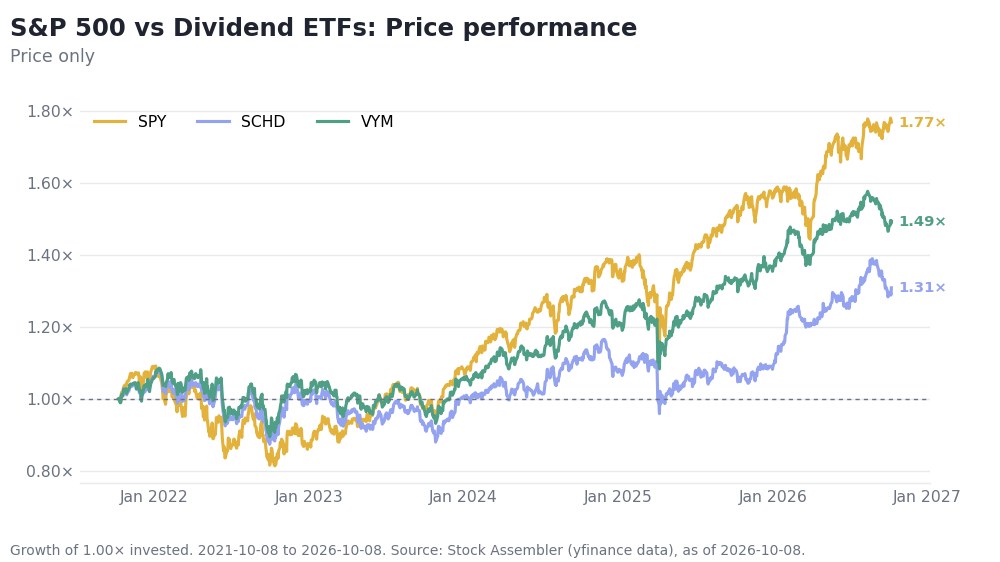
Growth of 1.00x invested, price only, October 8, 2021 to October 8, 2026. Data: Stock Assembler (yfinance).
The chart shows how the gap built. For roughly the first two years the three lines tangled together, and SPY spent stretches below both dividend funds. The separation came later, and it came mostly from SPY pulling away. SCHD, the highest-yielding of the three, ended with the smallest price gain.
That ordering is the mechanic worth understanding. A fund that pays out more of its return as cash has less left to show up in its share price. SCHD's trailing 12-month yield is 3.2%, VYM's is 2.3%, and SPY's is 1.0%. Price-only numbers understate the higher payers, so this chart is the least fair comparison of the three.
Reinvesting the income closes some of the gap, not all of it
Now put the dividends back. With distributions reinvested, SPY returned 89.0%, VYM returned 72.4%, and SCHD returned 56.4%.
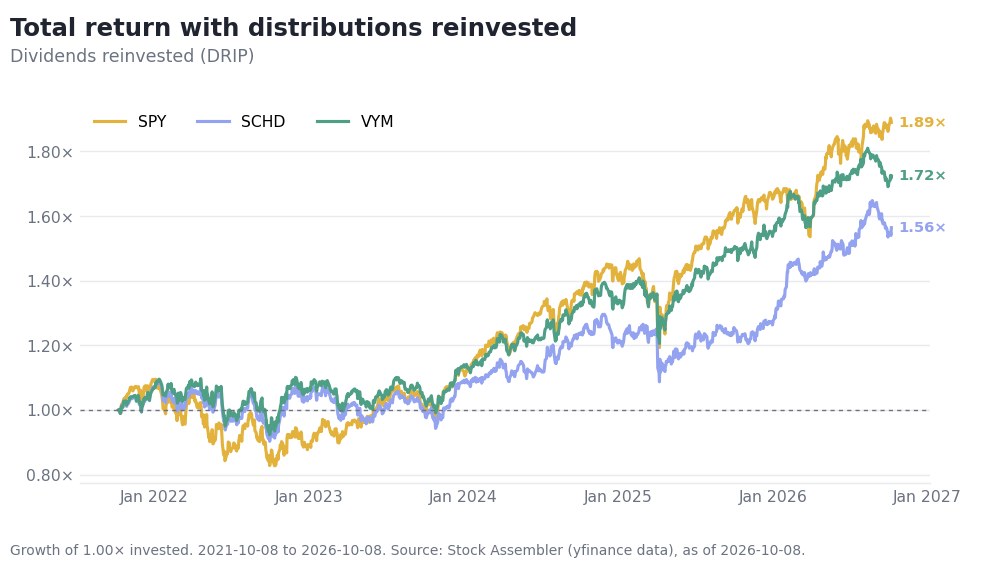
Total return with distributions reinvested, October 8, 2021 to October 8, 2026. Data: Stock Assembler (yfinance).
VYM's deficit to SPY shrinks from 27.5 percentage points on price to 16.6 percentage points with dividends reinvested. SCHD's shrinks from 46.0 percentage points to 32.6 percentage points. That is real help from the income, and it is what you would expect from the higher yields.
It still leaves SPY ahead of both. So this is not a story where yield secretly made up the difference. Over this window, it did not.
The data cannot settle rotation versus valuation
The original question was whether money is rotating out of dividend funds or whether the broad index has simply become expensive relative to them. These numbers describe what happened to returns. They do not measure fund flows or valuations, so I can't tell you which story is right from this data alone.
What I can say is that the pattern fits the idea that the index owns more of the fast-growing companies that drove the market, while dividend funds lean toward mature businesses that return cash. That is a reasonable hypothesis, and you can test it by looking at what each fund actually holds. I wouldn't treat it as proven.
The fair case for owning the dividend funds anyway
Five years is one window, and it was a good one for the index. A different starting date could produce a different ranking, and the chart makes that plain: in the early years SPY was the one trailing. Anyone who bought a dividend fund for steadier income instead of maximum growth got what they paid for.
Cash flow also has a behavioral value. Some investors hold through drawdowns better when a fund is paying them. If that keeps you invested, it is worth something that a total return table will not show.
But I'd push back on the idea that the income is a reason to ignore the gap. A dividend is a transfer from the fund to you, not extra return. Judge these funds on total return, then decide whether the income stream is worth the difference.
What to check in your own portfolio
- Compare your dividend holdings to SPY on a total return basis, with distributions reinvested, over the dates you actually bought.
- Look at the top holdings of each fund and ask what you own in one that you don't in the other.
- Decide whether you need the cash. If you are reinvesting every payment anyway, the income itself is doing little for you.
You can run this comparison on any pair of funds in Stock Assembler's Compare Tickers tool.
This post is for informational purposes only and does not constitute financial advice. Return figures from Stock Assembler's Compare Tickers tool (yfinance data), October 8, 2021 to October 8, 2026. Past performance does not guarantee future results.